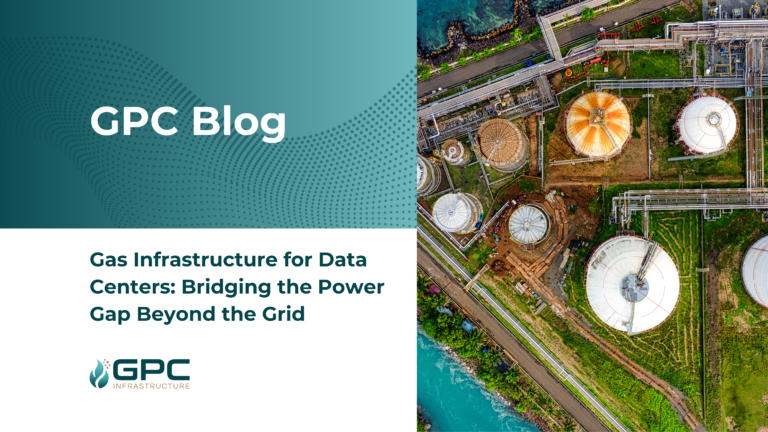
Gas infrastructure for data centers is becoming a critical advantage as AI drives unprecedented demand for power. While land, fiber connectivity and cooling remain essential, many developers are finding that reliable energy has become the deciding factor in whether a project moves forward. As utility interconnection timelines continue to grow, existing natural gas infrastructure is helping operators accelerate deployment and reduce dependence on grid expansion.
Across the U.S., electric utilities are struggling to keep pace with demand. Interconnection queues continue to grow, transmission upgrades can take years to complete, and developers are under pressure to deliver new AI capacity on aggressive schedules. As a result, many organizations are rethinking how they power new facilities and looking beyond traditional utility models.
Why the Grid Is Falling Behind
The electric grid was designed to support steady, predictable growth. Today’s AI workloads are creating power demands it was never designed to accommodate.
Hyperscale campuses and high-density compute environments require significant capacity on compressed development timelines. Unfortunately, expanding utility infrastructure is rarely a quick process. Developers must contend with permitting requirements, regulatory reviews, equipment shortages and transmission upgrades that can delay projects long after a site has been selected. These challenges are reflected in the latest Lawrence Berkeley National Laboratory interconnection queue analysis, which found thousands of proposed generation projects still awaiting grid interconnection across the United States.
Constraints like these are shifting the conversation from simply finding available power to finding power that can be delivered on time.
Why Gas Infrastructure Has an Advantage
Unlike new transmission systems, which often require years to develop, much of the nation’s natural gas pipeline network is already in place. Existing infrastructure gives developers another path to reliable energy without waiting for extensive grid expansion.
For data center operators, this creates several advantages:
- Faster access to dependable power
- Greater flexibility when evaluating sites
- Reduced dependence on constrained utility infrastructure
- Support for distributed, behind-the-meter energy strategies
- A scalable foundation for future campus growth
Natural gas infrastructure is not replacing the electric grid. Instead, it complements traditional utility service by helping operators secure the power they need when project timelines cannot wait.
Turning Existing Infrastructure Into AI-Ready Power
Existing pipeline infrastructure alone is not the solution. The real value comes from transforming that fuel source into dependable onsite power that supports modern AI workloads.
This is where distributed generation and Energy-as-a-Service models are changing the conversation.
Rather than relying exclusively on utility-delivered electricity, developers can leverage behind-the-meter generation to create dedicated power systems designed around the needs of a specific campus. These systems can improve deployment certainty while giving operators greater control over energization schedules and future expansion.
As AI demand continues to grow, speed to power is becoming just as important as total available capacity.
The Future of Data Center Power
Power has become one of the most important factors in data center development. Organizations that can secure reliable energy faster will be better positioned to meet accelerating AI demand and bring new capacity online.
Gas infrastructure for data centers is helping make that possible by providing a practical bridge between today’s utility constraints and tomorrow’s AI-ready campuses.
The future belongs to organizations that plan their energy strategy as early as they plan their site strategy. By leveraging existing infrastructure, behind-the-meter generation and turnkey Energy-as-a-Service solutions, developers can reduce uncertainty, accelerate deployment and build the resilient power foundation modern AI infrastructure demands.
Why It’s Time to Rethink Your Data Center Power Strategy with GPC
At GPC Infrastructure, we believe the future of data center growth will be defined by organizations that rethink power strategy early, including making turnkey energy-as-a-service the standard for AI-ready power.
Natural gas infrastructure, behind-the-meter generation, and modular energy systems are helping data center operators move beyond grid dependency and toward a faster, more resilient infrastructure model designed for the realities of AI-scale growth. Contact us today and learn how we can be your development partner.